
FAYN - January 23, 2025 - https://www.fayn.press/koy-okulu-neden-onemli/
The villages that were able to respond most quickly to the conditions following the February 6 earthquakes were those that still had a school. Yet, educational inequality in rural areas is profound. What are the ways to strengthen education in rural areas? How can multigrade classes be used to advantage? What can be done for village teachers?
"The earthquakes of February 6, 2023, forced us to confront many realities and learn lessons. One of these realities is that village schools are not just village schools; they are a shared space for the entire village, especially for children. The lesson here is clear: In times of crisis, villages and village schools are a crucial element of resilience.
This observation was made after the February 6 Kahramanmaraş Earthquakes in the Village Education in his video The name belongs to Okan Pala, who was the Research and Advocacy Coordinator of the Village Schools Exchange Network (KODA).
Pala is not alone in this observation.
Öykü Kocaman, a member of the KODA team who has been fighting since 2016 to ensure education continues in villages where children live, explains that their determination to do so was further strengthened after field observations in the areas affected by the earthquake on February 6, 2023:
"We heard dozens of firsthand stories that revealed how desperately the village needed the school, the school needed the teacher, and the teacher needed their students and parents after the February 6th earthquake. For example, in one village, the village teacher lived in the city center because his older children needed school, but when his house collapsed in the earthquake, his family came to the village and, by supporting their parents, survived. This also helped the children in the village, and therefore their families, establish new routines after the earthquake. This example alone is a valuable example. What does the village school mean to the village?makes it necessary to talk about it at length.”
KODA not only shares what they saw during the earthquake, but also the gains and experiences they have gained in their work in village schools over the last eight years. turning it into a series of articles Fayn shared with.
We have summarized for you the points of the article series that we read with great curiosity, which made us think, filled with life lessons that made teachers and students who went through village schools smile here and there, and made us believe in the necessity of village schools.
Are there really any village schools left?
A settlement that's far away, and even though we never go there or see it, it belongs to us. When most people think of a village, it's the first thing that comes to mind. In fact, lately, we don't seem to be so sure it's even there anymore. While there's a misconception that this settlement has largely disappeared, the truth is far from it. The figures indicate a significant population still living in the countryside.
17,3 million people, representing 14,7% of Türkiye's population, continue to live in areas classified as "rural," which constitute 93,5% of Türkiye's surface area. Of this population, 2,8 million are children under the age of 15.
There's no data showing how many schools are currently operating in areas classified as "rural" by TÜİK (Turkish Statistical Institute). Data from the Ministry of National Education is also incomplete. Therefore, we can't help but ask: "Are we providing a sufficiently high-quality education to children living in rural areas?"
If you are looking for a more detailed answer to the question of whether there are any village schools left, here it is: here.
Education inequality between urban and rural areas is very high.
According to the 2018 PISA results, students in urban areas across OECD countries outperform their rural counterparts by an average of 21 points. This difference doubles in Türkiye, reaching 42 points. In other words, the educational inequality between urban and rural areas is even greater in Türkiye than in other OECD countries.
There are many structural reasons for this situation, such as a lack of stimuli in educational settings. However, the real problem is the lack of a consistent and coherent policy approach that addresses the needs of villages.
The Multi-Classroom: Necessity or Opportunity?
When we talk about village schools, one of the first things that comes to mind is combined classes.
The practice of "multi-grade classes," which is a system where students from different grades study in the same classroom with the same teacher, has been used for years as an alternative solution in schools with low student numbers.
Multigrade classes, which are preferred in countries with strong education systems due to their benefits such as peer learning, are considered more of a disadvantage in Türkiye due to policy deficiencies.
The most significant of these policy shortcomings is the lack of sufficient focus in the teacher training curriculum on multigrade classes and teaching in rural areas. Teachers who have not received specific training for teaching in multigrade classes may naturally struggle to realize the benefits of this method.
A prospective teacher who has never had contact with rural schools during his education at the faculty of education may have difficulty adapting to the conditions there when he is assigned to a village.
Does education return with transported students?
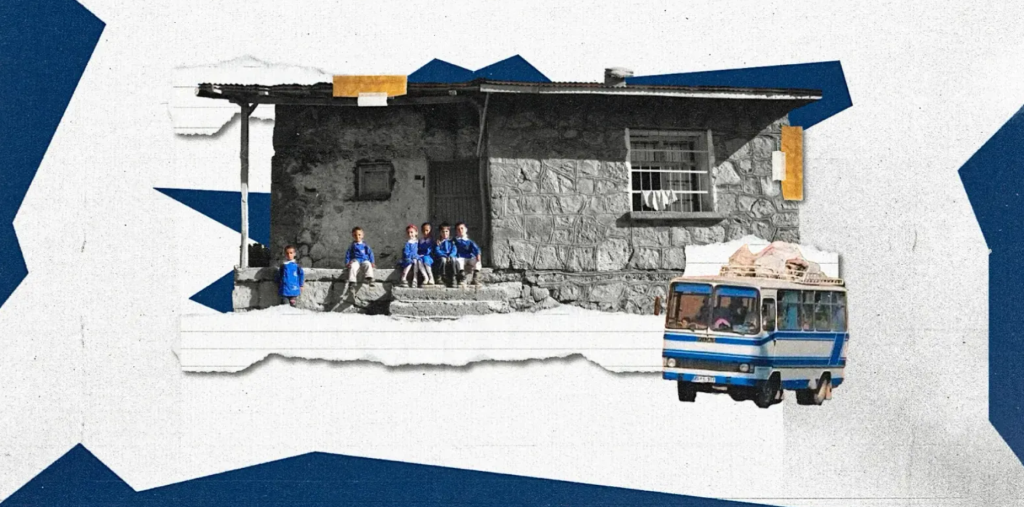
Another problem of rural education in Türkiye is transported education, that is, bringing children from villages to a more central school on a daily basis.
This option, available to students whose villages have no schools, means a daily struggle for students who have not yet reached the age of leaving their families and taking care of their own needs.
According to 2023-2024 Ministry of National Education statistics, there are 12 transportation center schools in Türkiye. These centers transport 921 primary school students and 258 secondary school students on a daily basis.
While it might initially sound like an efficient transportation system, transportation-based education is actually a process with many drawbacks. The first of these is the difficulties encountered during the transportation phase.
It's tiring enough for children to travel twice a day by school bus, covering distances of up to 30 kilometers. Furthermore, road and climate conditions can make this process even more challenging.
The congestion of the buses, the fact that children sometimes walk to and from the bus on foot, the fact that strangers can get on the buses, and the lack of a staff member to support the driver are also factors that pose various risks for students.
Transportation also sometimes poses an obstacle to establishing healthy school-family relationships. If a family already harbors negative preconceptions about education, the disadvantages of transportation can reinforce these preconceptions.
The fact that these families are less likely to cooperate with schools and teachers they do not know and have little contact with, and to contribute to their children's education, is an inevitable consequence of the lack of communication created by transported education.
One of the fundamental arguments for bussing education is that it's impossible to provide quality education in multigrade classrooms. However, it's possible to make multigrade classrooms an effective solution. All that's needed is qualified teachers and the right structure. This can pave the way for children to receive education where they live and achieve at least as much success as they would in bussed education.
For more details about these two applications, see the article prepared by KODA here.
Can village schools be attractive to teachers?
Another problem facing village schools is the lack of qualified teachers. By quality, I mean whether newly graduated teachers appointed to village schools were prepared to teach in the village while they were still prospective teachers.
Many prospective teachers actually anticipate starting their first assignment at a village school. These prospective teachers often choose village schools to fulfill their mandatory service obligations or to avoid being unemployed.
Most teachers When he went to the village school as his first duty station While realizing her dream of entering the profession, she must also confront her concerns. Sometimes, the story even begins before she even arrives in the village. Because the first questions are how to get there and where the teacher will be staying when the semester begins.
However, education in villages has both advantages and disadvantages due to the prevailing conditions. The ability to take advantage of natural resources and wide-open spaces, the ability to establish educationally supportive bonds with adults within the children's ecosystem, and the ability to closely monitor the individual developmental needs of a small number of students, as well as the respect afforded to the teaching profession in villages, are all elements that constitute the brighter side of the coin.
Is collaboration with families possible?
Rural families' perspectives on education, schools, and teachers are fueled by numerous prejudices and a sense of learned helplessness. Add to this the persistent disadvantages of schools located in the periphery, and these perceptions can become even more rigid.
Obstacles to the essential collaboration with families are manifold. These include the constant turnover of teachers at the school, the desire of well-liked and valued teachers to be assigned to central positions, poor communication between teachers and villages and families, and their lack of knowledge and tools to improve this.
These factors, which cause prejudices against schools and teachers to become ingrained over time, hinder school-family collaboration. For a more detailed reading on school-family collaboration in villages, here You can look at.
What kind of policy is needed for a good village school?
However, all these problems can be overcome with resolute policies. Chief among the necessary steps is to include greater emphasis on rural education in university teacher training programs and to create professional experience opportunities in rural areas for prospective teachers.
Developing a curriculum suitable for village schools, providing incentives to village teachers in various areas, and supporting village schools by the Ministry of National Education could also contribute to the solution of many problems. paid teaching Practices such as these, which create a profound difference within the teaching profession and cause completely different problems, reveal the need to develop a more holistic policy.
Need to change perspective
But what's truly crucial for educating rural children is the perspective prospective teachers must possess on certain critical points. For example, they must internalize the idea that equal opportunities in education and breaking the cycle of poverty in rural areas can only be achieved if every rural child has access to a quality education.
Another shift in mindset is necessary: understanding that children need to be heard, supported, and understood, and communicating that they shouldn't be compared to others. Reminding them that being consistent in communication with children and dedicating as much time as possible to them is another step in this process. This allows us to witness a child who feels valued and generously shares this sense of individuality with the entire village.
For if children continue their education in a village school, it means they have at least one teacher, parents gathering in the garden, land cultivated to sustain life, and transportation vehicles built for transportation. The presence of a school in the living space also ensures that the local cultural heritage that has survived to this day is passed on to the country's future.
That is why village schools need to be transformed and their quality improved.
One of the most important ways to achieve this is through education faculties. For a detailed reading on the educational processes of village teachers, here You can look at.